Monday, 13 November 2023

IMPACT OF SMOKING ON SOCIETY


                      IMPACT OF SMOKING ON SOCIETY 

Group 1 and 3 


Group 2 and 4 


Sunday, 12 November 2023

REASONS FOR DEATH AROUND THE WORLD


GLOBAL STATISTICS OF DEATHS DUE TO VARIOUS REASONS 


REASONS OF DEATHS

NUMBER OF DEATHS (%)


ACCIDENTS


35%


ALCOHOL


20%


DRUGS


14%


SMOKING


85%


AVERAGE SMOKERS AROUND THE WORLD


GLOBAL STATISTICS OF AVERAGE SMOKERS  


COUNTRY

PERCENTAGE OF SMOKERS


NAURU

52.1


RUSSIA

26.8

AMERICA


11.5

AFRICA


10.3

SWEDEN


6

Sunday, 22 January 2023

Rate of a reaction

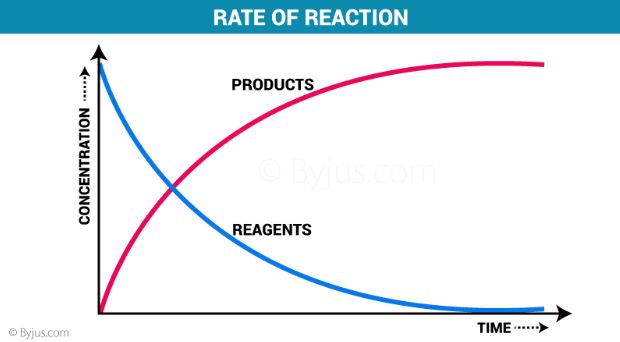
The rate of reaction refers to the speed at which the products are formed from the reactants in a chemical reaction. It gives some insight into the time frame under which a reaction can be completed. For example, the reaction rate of the combustion of cellulose in fire is very high and the reaction is completed in less than a second.

What is Reaction Rate?

The rate of reaction or reaction rate is the speed at which reactants are converted into products. When we talk about chemical reactions, it is a given fact that rate at which they occur varies by a great deal. Some chemical reactions are nearly instantaneous, while others usually take some time to reach the final equilibrium.

This article aims to help students learn about and understand what exactly is the rate of reaction for a given chemical compound.
Rate of Reaction


 Factors affecting the rate of reaction


The various factions that can affect the rate of a chemical reaction are listed in this subsection.


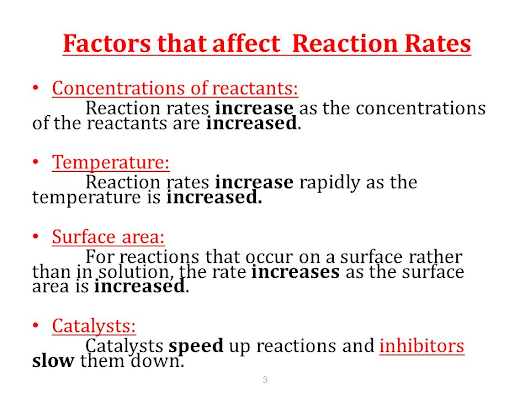
Effect of concentration on reaction rate

  • According to the collision theory, the rate of reaction increases with the increase in the concentration of the reactants.
  • As per the law of mass action, the chemical reaction rate is directly proportional to the concentration of reactants.
  • This implies that the chemical reaction rate increases with the increase in concentration and decreases with the decrease in the concentration of reactants.
  • Time plays a major role in changing the concentration of reactants and products. Therefore, even time is a vital factor affecting the reaction rate.

Recommended Videos


1,703

Pressure factor

  • Pressure increases the concentration of gases which in turn results in the increase of the rate of reaction. The reaction rate increases in the direction of less gaseous molecules and decreases in the reverse direction.
  • Thus, it can be understood that pressure and concentration are interlinked and that they both affect the rate of reaction.

How does temperature affect the reaction rate?

  • According to collision theory, a chemical reaction that takes place at a higher temperature generates more energy than a reaction at a lower temperature.
  • This is because colliding particles will have the required activation energy at high temperature and more successful collisions will take place.
  • There are some reactions that are independent of temperature. Reactions without an activation barrier are examples of chemical reactions that are independent of temperature.


Presence of Catalyst

  • A catalyst can be defined as a substance that increases the rate of the reaction without actually participating in the reaction. The definition itself describes its effect on chemical reactions.
  • The presence of a catalyst increases the speed of reaction in both forward and reverse reaction by providing an alternate pathway which has lower activation energy.

Surface Area of the Reactants

The surface area of reactants affects the rate of reaction. If the size of a particle is small, the surface area will be more and this increases the speed of heterogeneous chemical reactions.

More references

https://opentextbc.ca/introductorychemistry/chapter/factors-that-affect-the-rate-of-jjreactions/#:~:text=Reactant%20concentration%2C%20the%20physical%20state,factors%20that%20affect%20reaction%20rate.

https://byjus.com/chemistry/rate-of-reaction/


Sunday, 4 December 2022

                                 TRENDS  IN GROUP 2 ELEMENTS

The Group 2 alkaline earth metals include Beryllium, Magnesium, Calcium, Barium, Strontium and Radium and are soft, silver metals that are less metallic in character than the Group 1 Alkali Metals. Although many characteristics are common throughout the group, the heavier metals such as Ca, Sr, Ba, and Ra are almost as reactive as the Group 1 Alkali Metals. All the elements in Group 2 have two electrons in their valence shells, giving them an oxidation state of +2.


Trends in group 2 elements .

Group 2 elements are called alkaline earth metals. They are usually solid metals with high melting and boiling points.


Graph showing atomic size of elements in group 2


1. What is the trend in atomic size of atoms in group 2?

 2. Which is the smallest element  in group 2?

3. Radium is the last element in group 2? Predict the atomic size of radium.


1. What trend did you observe in the boiling and melting point of elements in group 2

2.Which element has the highest boiling point?

3. From the graphs, can you predict which element is the hardest in group 2?


Tuesday, 29 November 2022

Trends in group 1 metals

                      Trends in group 1 metals .

Group 1 elements are called alkali metals. They are usually solid metals with high melting and boiling points.

The alkali metals make up Group 1 of the periodic table. This family consists of the elements lithium, sodium, potassium, rubidium, cesium, and francium (Li, Na, K, Rb, Cs, and Fr, respectively). Group one elements share common characteristics. They are all soft, silver metals. Due to their low ionization energy, these metals have low melting points and are highly reactive. The reactivity of this family increases as you move down the table. Alkali metals are noted for how vigorously they react with water.


Trends in atomic size of group 1 metals


                       Trends in boiling and melting points 


Interesting Facts about Alkali Metals

  • Because they are so reactive with air and water, they are generally stored in oil.
  • Cesium and rubidium are used to make atomic clocks. Cesium clocks are considered the most accurate of all clocks.
  • Sodium and potassium both play an important role in biological life on Earth. We cannot live without them.
  • Sometimes cesium is also spelled "caesium."
  • They like to form salts by combining with halogens.
  • The name "alkali" is derived from the Arabic word for "ashes."
  • Different alkali metals burn with different colored flames including sodium (orange yellow), lithium (red), potassium (lilac), rubidium (red), and cesium (blue or violet).
  • All alkali metals have odd atomic numbers.
  • They are considered to be more similar to each other than any other group in the periodic table.
  • The compound ammonium has very similar properties to the heavier alkali metals.
  • When moving down the periodic table, each alkali metal has an increasing atomic radius as well as increasing reactivity.
Uses of alkali metals

Lithium, sodium, and potassium have many applications, while rubidium and caesium are very useful in academic contexts but do not have many
applications.

  • Lithium is often used in batteries, and lithium oxide can help process silica.
  •  Lithium can also be used to make lubricating greases, air treatment, and aluminum production.
  • Pure sodium has many applications, including use in sodium-vapor lamps which produce very efficient light .
  • Potassium has a vital rolel in biological system. KCl used as a fertilizer while KOH is used in the manufacture of soap.
  • Caesium is used making photoelectric cells

Refer this link to see the reaction of alkali metals with water

https://www.youtube.com/watch?v=M8Eovgaa2QE


STRUCTURE OF CARBON ATOM

  STRUCTURE OF CARBON ATOM